


Aerial pest control and 1080 FAQ
The Bovine TB National Pest Management Plan (TB plan) was approved by government in June 2016. It gives OSPRI a nationally coordinated and long-term approach to eradicating TB from New Zealand, with the aims of TB freedom in possums, cattle and deer herds by 2040 and prove TB free in all hosts by 2055.
Most of the time (more than 85%) OSPRI uses a variety of ground-based methods for possum control. However, to control possums over large areas of land or forest, or where the terrain makes access on foot difficult or inefficient, we use aerial control programmes.
Find out more in TB and pest control
We consult on our annual plans to get feedback. We may use the feedback to confirm plans. These FAQs provide additional background on aerial control and the use of 1080.
Use of 1080
The careful use of biodegradable 1080 to control possums has been a key tool for achieving the significant decline of TB-infected cattle and deer herds – from about 1700 in the mid-1990s to 20 in July 2026.
As well as reducing the risk of TB in cattle and deer herds, there are also large positive biodiversity benefits from using 1080 – particularly New Zealand’s native bush and birdlife. Intensive bird and bat monitoring following 1080 operations in Kahurangi National Park show that the nesting success of the area’s native bird species was significantly higher within pest control areas than outside.
OSPRI uses 1080 cereal bait because it’s the most effective means of achieving the possum control required to eradicate the bovine TB they carry. We do use other methods of population control too, and all these efforts are to safeguard cattle and deer herds, farms, the primary sector and New Zealand public from the impacts of TB.
While we look to minimise the amount of 1080 used within a pest control operation, the sow rate of bait and it’s toxicity needs to be enough for the exercise to be effective first time. Otherwise we risk bait shyness, and in turn ongoing TB in wildlife.
We recognise that people have different views, and wider concerns about the use of 1080 can also be raised with regulatory agencies.
While the toxin undoubtedly causes some animal suffering, this needs to be weighed against the benefits of rapid and effective pest control and implications of TB being left to spread in wildlife. OSPRI is always mindful of other approaches or products for pest control and weigh up what that means in terms of welfare, safety, and the environment.
While our work relates to disease management, the use of this bait also brings significant biodiversity gains. Possums in large numbers can destroy native bush and they, along with other predators (like rats and stoats), threaten the survival of native birds like the kiwi, whio and mohua.
In New Zealand, possums are the main maintenance host of TB in the wild (in other words, they can maintain this disease in their population), and in turn a risk to livestock. Once one cow or deer is infected, the disease can easily spread within the herd. Therefore, possums are the focus of OSPRI’s pest control operations, and critical to eradicating TB is the reduction of their numbers and keeping them low over time; around one to two animals every 10 hectares, for at least five years.
Ferrets and pigs are good indicators of TB in the possum population because they scavenge – so are highly likely to get TB from eating infected possum carcasses. Pigs can’t maintain TB within their own population, so if they are infected it means this has come from another species.
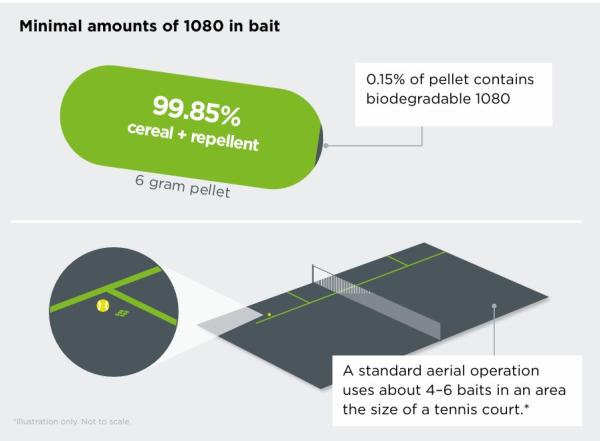
The cereal bait used has a 1080 content of 0.15%, which is enough for effective possum control. Through research and trials, sowing rates have reduced significantly and typically we now sow at 2kg/ha, which is about one bait for every 60 square metres.
Sowing rates are carefully considered before any operation. Factors are the length of time between pest control work, possum population density, and the land’s vegetation type.
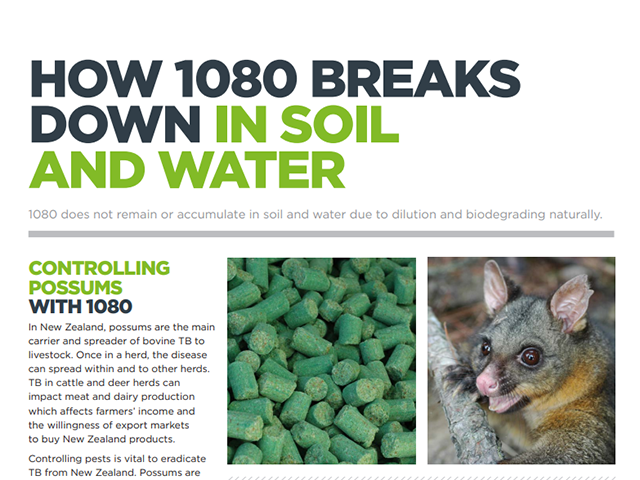
The bait containing 1080 breaks down over time in the environment through rainfall (it’s highly soluble) and natural biodegrading. Afterwards it does not accumulate or leave permanent residues in soil, plants, water or animals.
When using 1080 cereal bait, our contractors are governed by legislation, and must meet strict transportation, storage, handling, notification, and operational safety requirements.
Additionally, there’s quality assurance and monitoring in place, with OSPRI itself adding a layer of audit – to further ensure the precautions required are taken – before, during, and after each operation.
Control operations must also be approved by local public health officials, with specific consent conditions met to ensure everyone’s protection.
We use 1080 cereal bait because it’s the most effective means of achieving the possum control required to eradicate the TB they carry. Other predators (like rats and stoats) eat the bait, and this additional pest control aids native
birdlife. However, there is always the possibility of unintended by kill, and it’s hugely disappointing when it happens.
Considerable research has been completed on lowering the amount of bait used to reduce the chance of other animals encountering it.
Despite that, we’re very aware that work can risk wild deer and the inquisitive kea. Regarding our native parrot, DOC and OSPRI are working together, with joint research testing whether the bird repellent, anthraquinone, can be used to train kea to avoid 1080 cereal baits.
Alongside partners like Bioeconomy Science Institute (previously Landcare Research), we continue to investigate the effectiveness of deer repellents – in different seasons, landscapes, and species. Importantly, we continue to look for cost saving opportunities (through new products and sow rates) so we can use it more often.
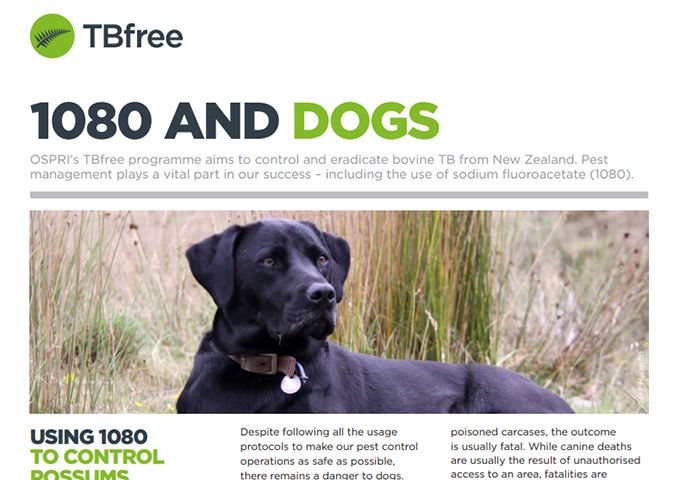
It’s important to understand that dogs are particularly susceptible to 1080 and can die from consuming only very small quantities of treated bait. In fact, after pest control, wildlife carcasses remain toxic to dogs until they have fully decomposed.
By nature, dogs tend to roam so they are at greater risk than other domestic animals. While OSPRI undertakes public notification, educates and warns through track signage, and funds free muzzles the most effective precaution is
distance. Keeping your pet, or working dog, well clear of any pest control area is the best way to protect it from accidental exposure to 1080.
Any dog fatality is treated seriously, it’s distressing for OSPRI’s people too, and all our operational practices are reviewed.
For more information:
After aerial application, most pellet baits will be eaten by the possums (or introduced pests). Any uneaten pellets will degrade; they’re made of cereal and quickly break apart when wet (so rainfall is an important factor in how quickly this happens) dissolving the 1080 which then leaches into soil.
Once in the soil, dilution continues with ground water and micro-organisms also present in soil degrade 1080 to mostly form a harmless acid (glycolate) and carbon dioxide. Alongside moisture, temperature is a real driver on how quickly process takes place. At cooler temperatures residual concentrations of 1080 reach undetectable levels within about 100 days.
More information
We completely understand that people may have concerns about OSPRI’s work, and any impact on water. Firstly, we assure you that there is no risk to public drinking water.
The bait containing 1080 breaks down over time in the environment through rainfall (it’s highly soluble) and natural biodegrading. Afterwards it does not accumulate or leave permanent residues in soil, plants, water, or animals.
Additionally, our aerial control operations follow strict conditions set by local health authorities – so that drinking water is protected, even if bait is used in parts of the wider catchment. This includes testing water for any sign of contamination.
What if carcasses end up in rivers and waterways?
Irrespective of OSPRI’s work, animal carcasses can end up in waterways, and these may release E. coli for a short period of time while decomposing.
Usually, these animals are dead stock that farmers will remove, and while it’s possible, pests targeted by aerially applied 1080 are not prone to being found in water later. Instead, when ill they tend to seek shelter.
Escherichia coli (E. coli) is bacteria found in the gut (intestine) and while most strains are harmless, some cause illness. E. coli can be found in water, and rain events can increase the levels of bacteria found in water courses
through runoff and surface flooding.
With dilution and in running water, levels of the E. coli bacteria reduce. As a short-term activity OSPRI is not required to test for E. coli, or other bacteria, following its work.
The use of GPS tools to exclude bodies of water or areas of water collection is common practice. We also work closely with individual land occupiers (like farms) using water supplies within or alongside pest control operations – ensuring all possible risks are mitigated.
For more information
OSPRI’s responsibility is to safeguard cattle and deer herds, farms, the primary sector and New Zealand
public from the impacts of bovine TB. We use 1080 cereal bait because it’s the most effective means of
achieving the possum control required to eradicate the TB they carry.
Regardless of our work, it’s understandable for people to have concerns about the use of a toxin in Aotearoa’s beautiful backyard. So, we know we need to help people with more information about 1080 and their environment. Our website is a good starting point, and we have people based throughout New Zealand you can talk to.
We also work closely with the Department of Conservation to make sure our work supports theirs. In 2011 the Parliamentary Commissioner for the Environment released a report evaluating the use of 1080 in New Zealand. She concluded, in the interests of native biodiversity, it should continue and in fact be increased.
For more information
Our aerial possum control operations
While possum control is mostly done using ground-based traps and hand-laid toxins, in some areas the most efficient method of control is aerial. During aerial operations, our contractors apply baits containing biodegradable 1080 from helicopters. Aerial control is efficient, cost-effective and extremely successful at reducing possum numbers to low levels.
The careful use of biodegradable 1080 to control possums has been a key tool in significantly reducing TB in cattle and deer herds. This occurs alongside TB testing of herds and livestock movement control.
Prior to any aerial application of 1080 cereal bait we consult with people and organisations who may be affected by the proposed disease control operations, including iwi, landowners and land users, farmers, hunters, and
people involved in outdoor recreation. We also involve the Environmental Protection Authority and the Ministry of Health and seek consent for our work.
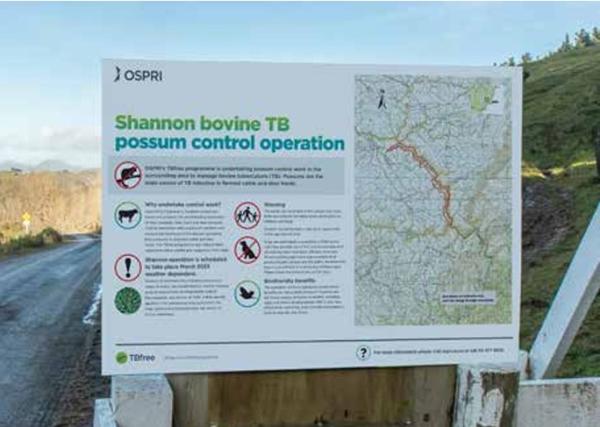
Before an aerial operation OSPRI erects information signs. They outline why the work is scheduled, when it will take place, safety precautions and show a map of the pest control area. These signs inform the public of the
danger of 1080 bait and possum carcasses. Information signs are additional to the required ’warning signs’, placed at all points of public entry by our contractor the time of operation.
Two flights occur, days apart. Firstly, a pre-feed (bait without 1080) and then the 1080 cereal bait. Weather is a big factor and safe application, flying and working conditions are paramount.
Bait is dispersed by helicopters with feed buckets, and advanced GPS navigational equipment ensure that bait is accurately sown and identified exclusion zones are avoided. There are strict procedures around working zones, including access and use of personal protective equipment.
The cereal bait used has a 1080 content of 0.15%, which is enough for effective possum control. Through research and trials, sowing rates have reduced significantly and typically we now sow at 2kg/ha, which is about one bait for every 60 square metres.
The bait containing 1080 breaks down over time in the environment through rainfall (it’s highly soluble) and natural biodegrading. Afterwards it does not accumulate or leave permanent residues in soil, plants, water or animals.
Signs remain in place during a caution period, and for public land, caution periods can be checked by referring to Department of Conservation’s pesticide summary interactive map.
Pest control operations are generally planned for winter. During these months food is less plentiful for possums, increasing the likelihood of bait acceptance, and people’s land use is at a minimum.
Directly affected or adjacent landowners are notified and visited well in advance of proposed operations, and engagement continues until work commences. OSPRI notifies landowners of the expected date of the aerial operation, although ultimately timings dependent on the right weather window – both for flying, and then feeding.
Warning and information signs
Before an aerial operation OSPRI erects information signs. They outline:
- why the work is scheduled
- when it will take place
- safety precautions
- a map of the pest control area.
These signs inform the public of the danger of 1080 bait and possum carcasses.
Children should be kept under strict supervision, and dogs must be kept out of the operational area (unfortunately they are highly vulnerable to 1080).
At the time of operation our contractor places additional ‘warning signs’ at all points of public access.
Signs remain in place during a caution period which depends on factors such as weather conditions and decomposition (typically 6 to 8 months). It is an offence to remove signage, and we urge anyone encountering them to follow the safety precautions.
More information
For public land, caution periods can be checked by referring to Department of Conservation’s pesticide summary interactive map.
Recreational hunting
We are committed to working with hunting organisations, as we carry out the TBfree programme. As an organisation, we also have a regional footprint, and this allows for grass roots consultation too.
We acknowledge concerns that planned aerial operations have potential to impact deer habitats, and we’ll continue to explore opportunity to lessen the impact of our activity. This may involve working in winter months, the use of deer repellent or splitting larger land areas (scheduling each half for pest control at a different time) to keep a nearby hunting ground open.
Unfortunately, accidental deer deaths do occur during our possum control operations, even with the use of deer repellent (which makes bait less palatable).
Together with researchers and suppliers, OSPRI is working to further reduce the risk to deer. Trials involve different seasons, landscapes, and deer species.
Through breeding, wild deer can have a population ‘replacement rate’ of up to 40%. Encouragingly, research over the last two years is telling us that the use of some deer repellents can reduce deer mortality to low levels.
More information
In 2021 OSPRI commissioned a study by Landcare Research monitoring South Island high country red deer before and after an aerial control operation involving repellent.
Wild deer are highly valued by hunters and some landowners. While 1080 bait is intended for possums, unfortunately deer are also attracted to it. Over time repellents have been developed that (when added to the bait) make it less palatable to deer.
In response to requests for greater use of deer repellent, OSPRI does encounter a funding challenge. Currently the use of deer repellent increases a control operation’s cost by up to 30%, so we consult with hunting organisations to best prioritise it’s use.
Alongside partners like the Bioeconomy Science Institute (prev. Landcare Research), we continue to investigate the effectiveness of deer repellents – in different seasons, landscapes, and deer species. Importantly, we continue to look for cost saving opportunities (through new products and sowing rates) so we can use it more often.