


TB Management in your area
Tuberculosis (TB) is a bacterial disease affecting cattle, deer, possums, humans, and other mammals. It threatens public health, agriculture, and New Zealand’s access to international markets.
OSPRI's TBfree programme aims to eradicate TB from cattle, deer, and possums by 2040. Achieving this goal depends on removing the disease from wildlife, particularly possums, which can spread TB to livestock. Possums are the main spreader of TB to farmed cattle and deer.
TB has already been eradicated from wildlife across more than 5.6 million hectares, with 4.8 million hectares still to cover.
A network of 100 TB Management Areas is reviewed each year. This helps OSPRI target pest control, wildlife surveillance, and contractor-led operations where they will have the greatest impact.
TB Management areas also guide engagement with farmers, landowners, community groups, and other affected stakeholders before, during, and after operations.
We review progress within each TB management area every year and use the information gathered to plan future pest control and surveillance activities.
How to use the map
- Find your property: click the magnifying glass button, then enter your address to see if we’re working in your area
- To zoom in and out use the + or - buttons
- For pop-up info about a TMA - click on the map
- Note: timing, location and boundaries of pest control work are subject to change and the activities shown are scheduled from July 2026 and June 2027.
Interpreting the map
Once you’ve selected the property or landscape you are interested in, coloured overlay will show if pest control or wildlife surveillance is planned.
Around 85 to 90 percent of possum control is carried out using ground-based trapping and poisoning methods. However, in areas with difficult terrain where ground control is not practical, aerial operations may be used.
With possum reduced to very low levels, TB is no longer able to be sustained within the treated area.
Around 85 to 90 percent of possum control is carried out using ground-based trapping and poisoning methods. However, in areas with difficult terrain where ground control is not practical, aerial operations may be used.
Aerial control accounts for only 10 to 15 percent of TBfree's possum control programme, with the majority of work undertaken through ground-based methods.
Planning and Preparation
Aerial operations are carefully planned, often up to two years in advance. Operational areas can range from approximately 1,000 hectares to more than 40,000 hectares and are carried out under strict:
- Health and safety requirements
- Monitoring programmes
- Public health consents
- Landowner consultation processes
Once an area has been identified through a TB Management Area (TMA) Plan, operational boundaries are confirmed and all required permissions, notifications and consents are obtained.
Pre-feeding and Baiting
Before toxic bait is distributed, the operational area is pre-fed with non-toxic cereal bait.
Pre-feeding helps possums become familiar with the bait and encourages them to seek out more of the same food source. Between 7 and 28 days later, cereal bait containing a measured dose of sodium fluoroacetate (1080) is applied.
Effectiveness
Aerial operations can reduce possum populations by up to 99 percent in a single night.
This rapid reduction helps:
- Interrupt the transmission cycle of bovine tuberculosis (TB)
- Remove the primary wildlife host of the disease
- Reduce possum, rat and stoat populations
- Create better conditions for native wildlife, including improved nesting success for forest birds
What Happens After an Operation?
Following an aerial operation, rainfall helps break down any remaining toxic bait into naturally occurring, harmless substances.
The forest environment remains largely unchanged, apart from the reduction of pest animal populations. With the primary host of TB removed, the disease is no longer able to be sustained within the treated area.
Protecting Public Safety
Public safety is an important part of every aerial operation.
Where walking tracks, roads, or other high-use public areas are located within the treatment area, they are checked and cleared of any remaining bait as soon as possible.
While GPS-guided technology ensures bait is distributed within approved operational boundaries, post-operational inspections are also carried out to identify and remove any stray bait.
Protecting Dogs and Waterways
Dogs are particularly vulnerable to 1080 poisoning, including through scavenging poisoned carcasses.
In areas popular with dog walkers, streams and waterways may be checked for poisoned animal carcasses. Any carcasses found are removed to help minimise the risk of secondary poisoning.
Where required by consent conditions, accredited research organisations may also test waterways for any traces of 1080.
Warning Signs and Monitoring
Warning signs are installed throughout operational areas to alert the public to risks associated with 1080.
These signs remain in place until monitoring confirms that baits and carcasses have broken down sufficiently and no longer pose a risk to people or dogs.
The length of the warning period varies depending on environmental conditions, including weather and the rate at which bait and carcasses decompose.
Ground-based control is the primary method used to manage possum populations, accounting for approximately 85 to 90 percent of all pest control operations.
Our pest control programme is delivered by experienced contractors, many of whom are local businesses with strong knowledge of the areas they work in.
Toxins Used in Ground Control
Contractors use a range of approved toxins, such as cyanide, depending on factors including the size, location and terrain of the treatment area.
Before any operation begins, contractors consult with landowners to ensure the chosen control method is appropriate and minimises risks to livestock, pets and native wildlife.
Toxins may be:
- Placed in secure bait stations
- Attached to trees in biodegradable bags
- Hand-laid in targeted locations
Trapping Methods
Where trapping is the most suitable control method, contractors use a range of trap types, including leg-hold and kill traps.
The type of trap used depends on several factors, including:
- Ease of access to the area
- Installation and maintenance requirements
- Potential risks to livestock, pets and native wildlife
Monitoring Possum Activity
To identify areas where possum control is needed, contractors may use monitoring tools such as:
- Corflute (corrugated plastic) chew cards
- Wax tags
These devices help measure possum activity and ensure control efforts are targeted where they will have the greatest impact.
Long-Term Disease Control
Ground control operations are repeated over time to maintain low possum numbers and reduce the spread of bovine tuberculosis (TB).
Operations continue within an area until wildlife monitoring and disease surveillance indicate that TB has been successfully eradicated from local wildlife populations.
OSPRI captures wild pigs in areas being surveyed. Samples from the animals are sent to a lab and checked for disease.
GPS data about capture locations forms a picture of TB infection in an area, so a plan can be built to eradicate it.
Why use wild pigs?
Possums are highly susceptible to TB and typically die within a few months of becoming infected, making them less effective for monitoring.
However, the disease rarely kills wild pigs, nor do they spread it. Pigs contract TB by eating carcasses of infected possums, and this makes them a valuable indicator species - helping us determine whether this disease is still present in wildlife in an area or not.
Confirming TB-Free Status
Wildlife surveys are one of the most effective tools for measuring progress towards TB eradication.
As infection levels decline, survey results help demonstrate whether disease control efforts are working and provide the evidence needed to confirm that an area is free from bovine TB.
TB Management outside of the pest control areas
If your property, or an area that you may be interested in, is not in a pest control area highlighted in the map, we may still working be working in your region undertaking TB testing or your area may be subject to movement controls.
You can find out more on the disease control area map . This provides information on:
- the disease control area type your property sits in
- Any movement control requirements such as pre-movement testing
- How often your property needs to be herd tested for TB.
You can confirm if your property is within a disease control area by calling our support team on 0800 482 463.
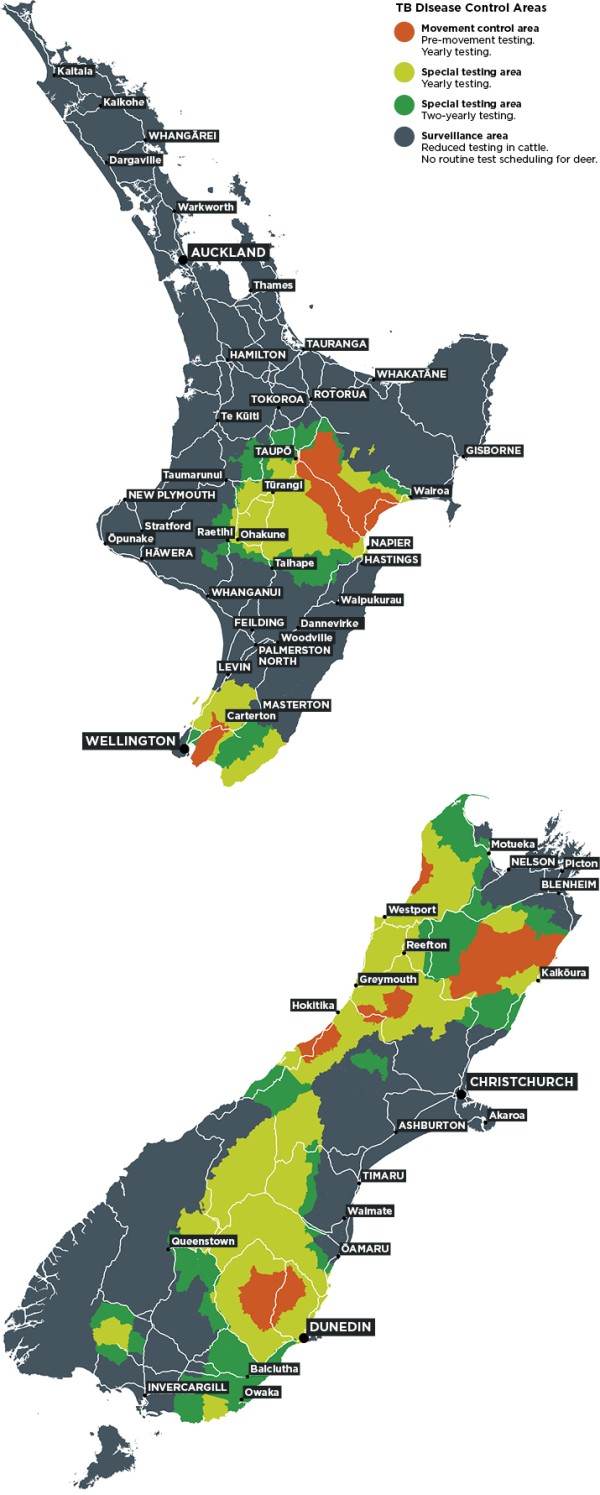
Four types of disease control areas
New Zealand is divided into four disease control area types. Each area has different TB testing frequencies and movement control measures, depending on the risk of TB being transferred from infected wildlife — mainly possums — to cattle and deer.
- Movement control area: In movement control areas, all cattle or deer on a farm are tested annually. Cattle over three months and deer over eight months of age must have a TB test before they move within a movement control area. You must complete the movement within 60 days of the pre-movement test. Stock going direct to slaughter don't require a pre-movement test. Moving animals from a Movement Control Area (MCA)
- Special testing area — annual: In these areas, cattle over 12 months and deer over 15 months of age are tested annually.
- Special testing area — biennial: In these areas, cattle and deer over 24 months of age are tested every two years.
- Surveillance area: In these areas, testing is completed on farms with a higher risk of contracting or spreading TB. Risk factors include:
-
- higher frequency of animal movements on or off the farm
- animal movements from higher-risk herds or areas (like those under movement control)
- poor quality NAIT records.
This may mean we call some farms to present animals for TB testing sooner than expected (after their last whole herd test). Other farms may not hear from us for long periods.
Response in areas with TB
There are a number of TMAs in the country where TB has been found. These are subject to eradication programmes, TB testing and movement control.
You can find regional information for: