


About the Mycoplasma bovis (M. bovis) programme
Purpose of the M. bovis programme
The M. bovis programme aims to:
- contain and control M. bovis in New Zealand, and ultimately prove confidence that M. bovis is absent in our national cattle herd
- reduce the impact of the disease and the programme for everyone affected by M. bovis
- strengthen New Zealand's biosecurity system.
Three phases of the M. bovis programme
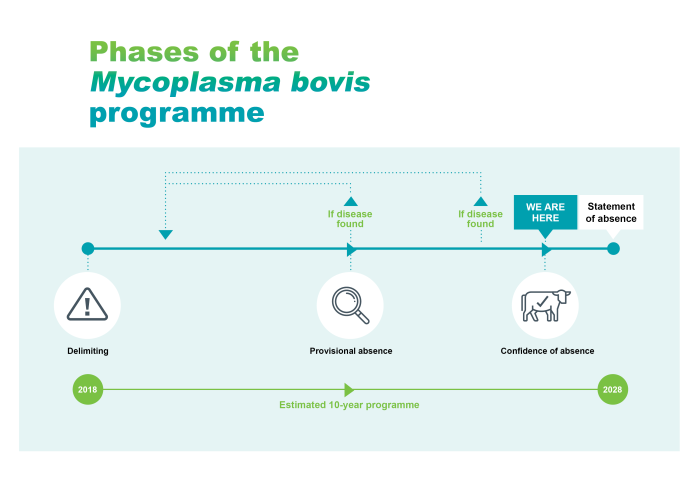
The M. bovis programme started in 2018 and is estimated to finish in 2028.
We need to pass through 3 phases to provide confidence that M. bovis is absent in our cattle herd.
- 1 Delimiting — in this phase, we identify and remove cases of infection.
- 2 Provisional absence — in this phase, we focus on monitoring the cattle population through background surveillance. We need 2 consecutive clear spring and 2 consecutive clear autumn calving periods to build up a good level of confidence that M. bovis is no longer present.
- 3 Confidence of absence — in this phase, background surveillance continues until we achieve a very high level of confidence that M. bovis is eradicated. This phase is expected to run for 2 years. The confidence of absence phase ends with a statement of absence and M. bovis is then considered exotic.
Origin of M. bovis in New Zealand
In July 2017, a vet identified M. bovis for the first time in New Zealand at a property in South Canterbury.
Evidence suggests that the M. bovis found in New Zealand spread from a single case, which probably entered the country in early 2015. We may never know exactly how this happened, but the most likely route is through imported bovine semen. The Ministry for Primary Industries (MPI) is testing some imported bovine semen held in New Zealand to ensure that it does not contain M. bovis. To find out more, please visit MPI's website.
A new Import Health Standard for bovine germplasm took effect in May 2022, which improved risk management. The risk of M. bovis spreading through imported bovine semen is now considered very low.
Establishing the M. bovis programme
In 2017, MPI took action to contain M. bovis and set up a response under the Biosecurity Act 1993.
In May 2018 — after consultation with industry — MPI, along with DairyNZ and Beef + Lamb New Zealand, agreed to enter a Government Industry Agreement partnership to jointly manage and share programme costs. They did this because achieving confidence of absence was technically possible. Also, allowing M. bovis to spread would risk animal welfare and cost the farming sector about $1.3 billion in lost productivity in the first 10 years, with continued losses after that. In comparison, the estimated cost of the programme was $870 million over 10 years.
In late 2023, the day-to-day operational and disease control functions of the programme moved from MPI to OSPRI.
In early 2025, the programme framework changed to a National Pest Management Plan (NPMP). An NPMP — the same framework used for bovine TB — allows OSPRI to administer and manage the programme for the remainder of the plan.
M. bovis programme funding structure
M. bovis programme funding is split between government (68%) and industry (32%). Of the industry share (collected through farmer levies):
- dairy farmers pay 94%
- beef farmers pay 6%.
Farmer levies are applied on the production of milksolids and slaughter of cattle. This split between dairy and beef farmers is set out in a funders' agreement and reflects the proportionate risks and benefits to each industry.
Funding is subject to an annual recociliation and adjustment - which includes a forecast of costs to complete the programme's objective; eradication of M. bovis in New Zealand.
Maximum and actual rates of levies are set as follows.
For dairy:
- A maximum rate of 1 cent per kilogram of milksolids produced in New Zealand by a dairy farmer for supply to a dairy processor.
- An actual rate of 0.0 cents* (plus GST) per kilogram of milksolids produced in New Zealand by a dairy farmer for supply to a dairy processor, which took effect from 1 August 2026.
* While this levy will remain in place, and continues to be subject to change annually, currently we forecast that the programme has sufficient funds to continue for the next period and therefore the reduction to 0.0 cents. The M. bovis Programme is now in its final phase called 'Confidence of Absence', whereby testing continues to gather sufficient data to prove M. bovis is no long present in the national herd.
For beef:
- A maximum rate of 80 cents per head for beef cattle slaughtered.
- An actual rate of 40 cents (plus GST) per head for beef cattle slaughtered, which took effect from 1 October 2025.