


OSPRI News: November 2026
OSPRI News November 2026
RUSH to build the new NAIT system
 The company behind New Zealand’s ‘COVID Tracer app’, and Z Energy's app, has been selected to build the replacement system for the National Animal Identification and Tracing (NAIT).
OSPRI is pleased to announce that digital engineering company RUSH will tackle this project and completely upgrade the software used by farmers every day to register cattle and deer and record their movement.
RUSH was selected for the project because of their proven track record delivering complex digital solutions, and prior experience of working with the primary sector, having built the FarmlandsPRO app.
It's an exciting partnership and we look forward to delivering a rebuilt NAIT.
TBfree progress in Central North Island
 From next month, around 240 farms, situated in either Broadlands (east of Taupō) or coastal Hawke's Bay, will no longer need to test cattle or deer herds for signs of TB prior to moving them.
Progress in controlling TB in possums supported by insights through wildlife surveillance, and ongoing support for affected farms, has enabled some relaxation of animal movement restrictions in the area from the 10th of December. These herds will then move to an Annual Special Testing Area classification, where yearly whole-herd testing will remain for cattle over 12 months and deer over 15 months.
This change takes effect on 10 December, and the farms it applies to were advised directly by email and post this month.
It’s a small but positive step towards eradicating TB from New Zealand, and not one that could be made without local farmers' commitment to testing their animals and timely use of NAIT.
For more information about disease control areas in other regions visit our disease control map.
Community informs our possum control
 During a recent public consultation, OSPRI received 69 submissions on six proposed aerial 1080 TB control operations over 2027. The work planned focusses on reducing possum numbers in Central North Island and Otago - the two farming areas most affected by spread of TB into livestock in New Zealand.
Feedback highlighted hunting interests, the timing of work (where possible avoiding ‘the roar’) and the need for clear communication. The use of deer repellent was the most frequently raised topic, particularly in relation to the Kaweka area, and while many submitters supported its use views differed on how it could be funded. There were also calls to reinforce the risks to dog safety, share monitoring results, and provide clarity on how this work specifically supports long-term TB eradication.
OSPRI will consider the feedback alongside additional considerations (these can range from technical and scientific advice, statutory requirements, as well as operational constraints) and will continue to engage with iwi, farmers and landowners - before any final decisions are made or published.
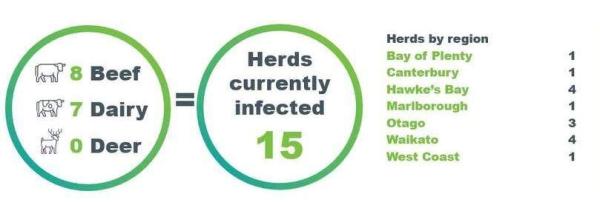
National TB infected herd update
as at 13 November 2026
OSPRI's Annual Report is out now
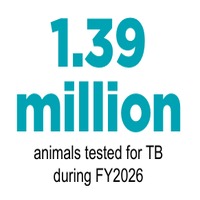 OSPRI’s 2025 - 2026 Annual Report is now available, reporting on progress against our medium-term strategy (to 2028), including what we achieved, where we didn’t meet our targets, and the work still ahead.
Highlights of interest for farmers include:
- Over 1 million hectares removed from TB Vector Risk Area status
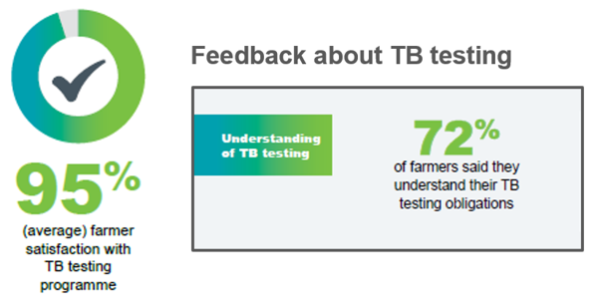
- 95% average farmer satisfaction in our first full year of delivering on-farm TB testing ourselves
- Zero active confirmed properties in the M. bovis Programme at year end
- A contract signed for the NAIT replacement system, with discovery work complete and design now beginning
- Of course, there's more to do, including reducing TB infected herd numbers and improving lifetime traceability.
You can check out OSPRI's Annual Report 2025 - 2026
Survey findings help guide improvement
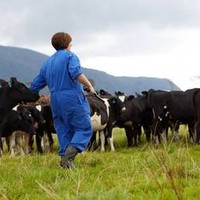 Thank you to everyone who took part in OSPRI's first annual stakeholder survey.
From the farming community we received over 1,200 responses, providing valuable insights into what's working well, where we can do better, and how we can better support the people who work with our programmes every day.
For example, while farmers were overwhelmingly satisfied (at 95%) with their experience of OSPRI's on-farm TB testing programme, 28% of farmers indicated they didn't know their testing obligations. This tells us we can do more to explain the requirements for testing herds by farm location.
The results also show continued support for the purpose and outcomes of our programmes, alongside the effectiveness of our efforts - and we're already using the findings to prioritise improvements to farmer communications, education and service delivery.
This survey also establishes our first organisation-wide benchmark of farmer and stakeholder sentiment, helping us measure progress over time.
You'll find more detail about the findings in OSPRI's Annual Report.
Three years on: progress towards eradication of Mycoplasma bovis
 On 1 November 2026, OSPRI marked three years since taking over responsibility for leading New Zealand's Mycoplasma bovis (M. bovis) eradication programme.
Since the programme began in 2018, farmers, industry partners, the Ministry for Primary Industries, and OSPRI have worked together towards the ambitious goal of eradicating Mycoplasma bovis from the national cattle herd. Significant progress has been made through a carefully managed eradication pathway, and while ongoing surveillance remains an important part of the programme, efforts remain on track.
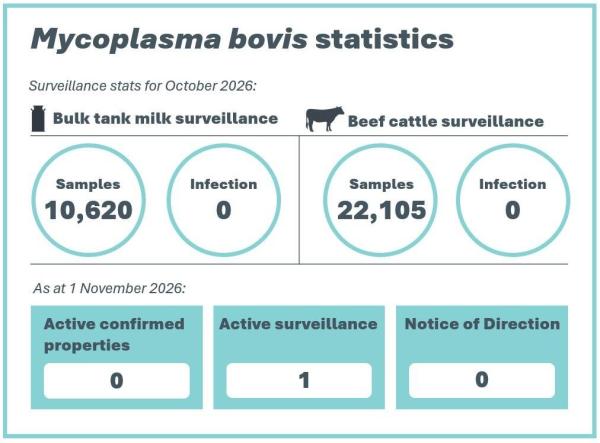
Properties in the M. bovis programme are categorised as: Active Surveillance, Notice of Direction, Active Confirmed Property, and Cleared Confirmed Property.