

Bovine tuberculosis, otherwise known as TB, has been part of the New Zealand landscape since the mid-19th century. Over the past decade we have been edging closer to eliminating bovine TB from the landscape. We have gone from 1700 herds in the 1990s to less than 30 in 2023. Because possums are the main spreader of the disease to cattle and deer herds, pest management is a major part of the program. An example of how well our eradication program is working can be seen in the upper South Island in high country stations such as Muzzle, Bluff and Molesworth.
Kevin Crews – Senior Veterinarian, OSPRI – This is where the TB problem in North Canterbury Marlborough probably originated in the 1960s. Basically, it's been a progressive strategy over the subsequent 50-plus years since then, driving it back to where it's come from. So now we're on the home straight, which is why getting TB out of the Clarence Catchment is a critical part of the success, not just of the strategy in the local area, but the TB plan nationally.
Jim Ward – Station Manager, Molesworth – We had TB in pigs deer, goats, cattle, possums, ferrets everything. It was just rampant. It was basically what didn't have TB for a wee while there.
Richard Murray – Bluff Station – Yeah, it's been a long, slow, difficult process but we've made huge progress. We were determined to get through it and with the research and development that's been done and the continued persistence, we've actually achieved the goal, probably a little bit quicker than what we envisaged at the time.
Guy Redfern – Muzzle Station – When the government's policy changed, I think to eradicate TB in the country, we became a priority from that. We just did one round of 1080 poison really, we were clear within two years, which was awesome.
Heather Alexander – Regional Partner, OSPRI – The TB control work that we do here at Molesworth and in the high-country stations is absolutely vital. We need to work in partnership with the landowners, iwi, and local communities to ensure that we're getting the job done in a way that's sustainable and has minimal impact on the land users.
Jim Ward – The crux of this has been at OSPRI all the way through, had a mindset of not only ridding the property of TB, but also coming up with best practice and best practice back in 2001 is far different from the best practice of 2022. Along the way, you know, they're finetuned all their operations, their consultation the collaborative approach they've taken with getting information from the guys on the ground... the pest operators that we have, the scientific community, the contractors that utilize the work, the aerial application, the helicopter firms that do the work.
That’s a hugely professional operation and OSPRI have been just tweaking it all the way through.
Heather Alexander – Recently we trialled a new deer repellent and a low-so approach. This meant we were applying less bait per hectare than our standard operations. The associated research proved that even using these new technologies and this new method we can still achieve our 2026 and 2040 objective.
Jim Ward – It was based around getting the science up and going, what suits a dry land operation, which essentially we are. A lot of the work was dovetail in, we did a lot of trial work, low sow rates, pulse feeding. A lot of effort went in. We trapped and collared possums, ferrets, pigs, deer, you name it. There was a lot of research that went into it. So, it has been a long journey but a great journey.
By 2026, OSPRI aims to be TB-free in cattle and deer herds in New Zealand but even if this is achieved the threat of TB still remains until the wildlife source is removed.
Hamish Murray – Bluff Station – It gives me got a little bit of butterflies to think that we could get away from being annual in pre-movement testing. I know it's going to happen but I don't allow myself to think that yet. I still feel like we've got to ensure and see the strategy through. I can't really think about what that would mean, but it is significant, the time that it would allow us to do other things is massive.
Guy Redfern – People argue about bird life and things or at home. Our birdlife just, you know, quadrupled, probably to be honest. It's just great not seeing a single possum. All our fruit trees have got fruit.
Colin Nimmo – Muzzle Station – As far as the continuing story of TB I think that people need to realize that it will spread if it's not controlled. That we need to keep going at the job, we need to finish it off. What we need to do now is get rid of the little pockets of TB that are left because, a bit like a lot of things in New Zealand, once you take your foot off the hammer it'll just come back again. So we have the most essential thing is that we get rid of the pockets of TB that are liable to reinfest the country that is now clear.

Molesworth Station TB response
Molesworth is the focus of a 9-year programme of targeted herd TB and wildlife surveillance, farm and stock management, possum control, and research.
Molesworth Station is New Zealand’s largest working farm, spanning 180,787 hectares in the mountainous landscape of the northern South Island high country.
Although the Molesworth cattle herd experienced a brief period free of TB, it has otherwise faced over 30 years of recurring infection, making it the longest-standing TB-infected herd.
Molesworth Station has entered into a partnership with TBfree New Zealand to undertake local wild animal control on the station. We have achieved significant reductions in the number of TB infected animals within the herd.
Current operational progress
| Operation | Approx. hectares | Status |
|---|---|---|
| Severn | 2027 | Operation scheduled for May 2026 |
| Tarndale and Bush Gully | 87,000 | Operation complete 2023 |
| Yarra/Five Mile | 7700 | Operation complete 2023 |
| Acheron East | 62,500 | Operation complete 2022 |
| Tarndale and Bush Gully | 68,000 | Operation complete 2021 |
| Saxton Strip Sow | 6200 | Operation complete 2021 |
| Severn Low Sow | 5400 | Operation complete 2021 |
| Yarra/Five Mile | 7700 | Operation complete 2021 |
Coming up the home straight — A high country journey to TB freedom in New Zealand
TB in Molesworth/Clarence Reserve TMA
To help eradicate TB from New Zealand, we've implemented a framework of TB Management Areas (TMAs) around the country. TMAs are areas with known TB infection in livestock and wildlife.
We are taking a multi-pronged approach to eradicating TB in the cattle herd and possum population at Molesworth Station. We do this through:
- herd TB testing of all age groups annually
- TB surveillance at slaughter
- farm and stock management practices to monitor TB risk
- pest management — control and surveillance
- research and innovation.
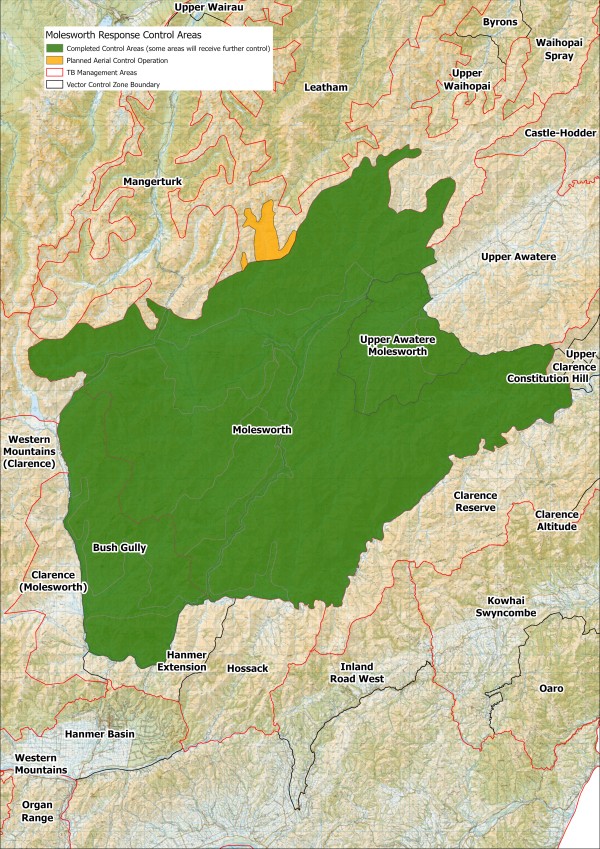
Map of Molesworth control areas
Pest control programme
Molesworth Station is divided into blocks for possum control work. We achieve full coverage every three years.
Due to the mountainous nature of the environment, aerial methods of pest control ensure full coverage, and best use of time and resource.
Successful trials of aerial low sow baiting
In June 2021, we trialled two new approaches to aerial baiting.
- Severn Trial Area — we treated 4,868 hectares with 50% less bait (1 kilogram per hectare). We used standard broadcast methods, so achieved complete coverage.
- Saxton Trial Area — we treated 4,356 hectares with 60% less bait (0.8 kilograms per hectare). In this case we applied bait at 2 kilograms per hectare in 30-metre-wide strips, with non-treated gaps of 100 metres between strips.
Both trials achieved 100% poisoning of possums with lower sowing rates shown to be effective in dryland habitat where bait easily reaches the ground.
Due to the success of the trials in this high country environment it will be a method that we use for future aerials here and in the Northern South Island high country.
Hunting on Molesworth
Hunting is restricted on Molesworth as it is both a recreation reserve and a working farm. We need to balance the requirements of both.
Red deer, chamois, goats and pigs are found on the station, and hunting is restricted at times, such as during the annual goose hunt.
We consult annually on our pest control operations.
Reducing deer deaths during Molesworth possum control
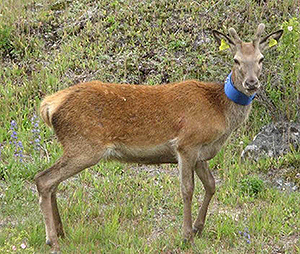 Accidental deer deaths occur during our possum control operations, even with the use of deer repellent bait.
Deers are not the target of our aerial vector control operations. We first trialled a new deer repellent in Molesworth in 2021 and determined it successful in reducing unintended deer by-kill.
Where consent conditions allow, we will consider the use of deer repellent in cereal bait for all aerial operations in the Upper South Island.
Downloads
1080 and dogs
PDF 640 KB
TBfree - Deer repellent for 1080 baits
PDF 295 KB
TBfree - How 1080 breaks down in soil and water
PDF 866 KB
TBfree - TB information for hunters
PDF 526 KB
Using 1080 for possum control
PDF 873 KB
Research paper
High effectiveness of deer-repellent Prodeer 1080 possum bait in the northern South Island high country — (R-1005) Morriss, G, Yockney, I, Nugent, G. 2021.